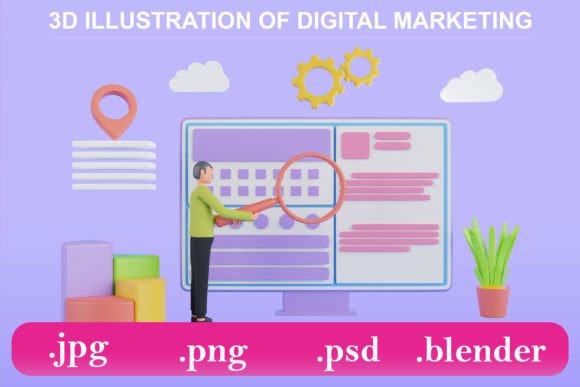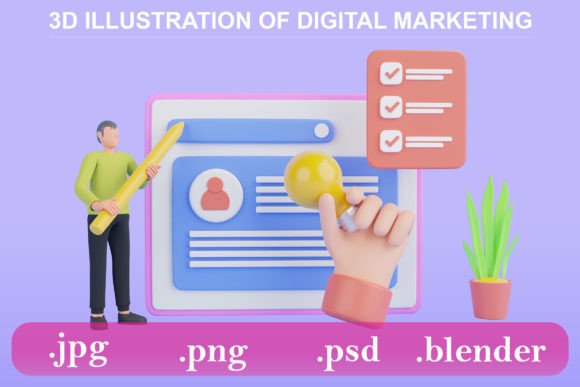
3D Illustration of Online Marketing: A Visual Guide to Digital Strategies
In the fast-evolving world of online marketing, visual communication has become a critical tool for conveying complex ideas. Among the many approaches, 3D illustration of online marketing stands out as a powerful method for simplifying and enhancing digital strategies. This technique uses three-dimensional visuals to represent marketing concepts, making them more engaging and easier to understand.
For professionals in digital marketing, content creation, or business development, 3D illustrations offer a fresh perspective on how to present information. Whether you're explaining social media algorithms, SEO processes, or customer journey maps, 3D visuals can help break down abstract ideas into digestible formats.
Understanding 3D Illustration of Online Marketing
3D illustration of online marketing refers to the use of three-dimensional graphics to visualize various aspects of digital marketing. These illustrations can depict elements like search engine optimization (SEO), content marketing, email campaigns, and social media engagement. By adding depth and realism, they make it easier to communicate intricate processes and relationships between different marketing components.
Unlike traditional two-dimensional diagrams, 3D illustrations provide a more immersive experience. They allow viewers to see how different parts of a marketing strategy interact, offering a clearer understanding of the overall system. This makes them particularly useful for educational purposes, presentations, and client communications.
Key Characteristics and Strengths
One of the primary strengths of 3D illustration of online marketing is its ability to simplify complex topics. For instance, an illustration of a customer journey can show how users move from awareness to conversion, highlighting touchpoints and decision-making stages. This visual approach helps stakeholders grasp the big picture without getting lost in details.
Another advantage is its adaptability. 3D illustrations can be customized to fit specific industries, target audiences, or marketing goals. A B2B company might use them to explain lead generation pipelines, while an e-commerce brand could visualize product discovery and purchase funnels. The flexibility ensures that the visuals remain relevant across different contexts.
Additionally, 3D illustrations enhance user engagement. Studies show that people retain information better when it's presented visually. By incorporating motion, lighting, and perspective, these illustrations capture attention and improve comprehension, making them ideal for digital content such as videos, infographics, and interactive web experiences.
Practical Applications and Real-World Use
3D illustration of online marketing is widely used in educational platforms, marketing agencies, and corporate training programs. It’s especially valuable when explaining technical concepts to non-experts. For example, a marketing consultant might use a 3D animation to demonstrate how Google’s algorithm evaluates website quality, helping clients understand the importance of content optimization.
In addition, these illustrations are beneficial for storytelling. Brands can use 3D visuals to create narratives around their products or services, making their messaging more compelling. A startup might illustrate its growth trajectory through a 3D timeline, showing how each marketing initiative contributed to its success.
Moreover, 3D illustrations support data-driven decision-making. When presenting analytics reports, a 3D graph or chart can highlight trends and patterns more effectively than static images. This makes it easier for teams to identify opportunities and refine their strategies based on visual insights.
Quality, Usability, and Reliability
The effectiveness of 3D illustration of online marketing depends largely on the quality of the design. High-resolution visuals with accurate proportions and realistic textures ensure that the message is clear and professional. Poorly executed illustrations, on the other hand, can confuse viewers and undermine credibility.
Usability is another important factor. The illustrations should be easy to interpret, even for those unfamiliar with 3D graphics. Clear labeling, consistent color schemes, and logical layouts contribute to a more user-friendly experience. Additionally, the visuals should be scalable, working well across different devices and screen sizes.
Reliability is also crucial. When using 3D illustrations for business purposes, it’s important to ensure that the content remains up-to-date. As marketing strategies evolve, the visuals should reflect current best practices and industry standards. This requires ongoing maintenance and revisions to keep the material relevant.
Who Benefits Most from 3D Illustration of Online Marketing
Professionals in digital marketing, especially those who work with clients or teams, will find 3D illustration of online marketing highly beneficial. It allows them to communicate complex ideas more effectively, whether during client meetings, team briefings, or training sessions.
Entrepreneurs and small business owners can also benefit by using 3D illustrations to explain their value propositions. For instance, a local service provider might use a 3D animation to showcase their process, helping potential customers understand what to expect.
Content creators and educators can leverage 3D illustrations to enhance their materials. Bloggers, YouTubers, and course instructors can use these visuals to make their content more engaging and informative, increasing audience retention and interaction.
Limitations and Considerations
Despite its advantages, 3D illustration of online marketing does have limitations. Creating high-quality 3D visuals often requires specialized skills and software, which can be time-consuming and costly. Not all businesses may have the resources to produce these illustrations in-house.
Additionally, the effectiveness of 3D illustrations depends on the audience’s familiarity with the subject matter. While they can simplify complex topics, they may not always be the best choice for very technical or niche audiences. In such cases, a combination of 3D visuals and detailed explanations may be necessary.
It’s also important to consider accessibility. Some users may have difficulty interpreting 3D visuals, especially if they have visual impairments. Providing alternative text descriptions or supplementary information can help ensure that the content is inclusive and accessible to all.
Final Thoughts
3D illustration of online marketing offers a unique way to visualize and explain digital strategies. Its ability to simplify complex ideas, enhance engagement, and support data-driven decisions makes it a valuable tool for professionals in various fields. However, its success depends on quality, usability, and relevance to the intended audience.
For those looking to improve their communication, education, or content strategy, 3D illustrations can be a powerful asset. By choosing the right approach and ensuring clarity, businesses and individuals can unlock new ways to connect with their audiences and achieve their marketing goals.